
Written at B2. Vocabulary to C1. | ~12 min read
This is an opinion piece. I’m not telling you what to think. I’m asking you to think.
One article, one level of English, two levels of vocabulary. The sentences are written at B2 so they stay readable. The vocabulary box in each section is tagged: [B2] items are the core, [C1] items are the stretch. Take whichever you need, ignore the rest. If you would rather do this than read it, there is a self-study version you can run on your own with any AI, and a free three-level lesson if you teach.
Somewhere in Germany this morning, a man in his mid-forties fed his sourdough starter. Then he checked the grind size on an espresso machine roughly the size of a small motorbike. Then he went out on a gravel bike that he had researched for months.
He is fine. He is, in fact, extremely fit.
But according to the newspaper article that started my whole week, he is also having a midlife crisis. Just a quieter one than his father’s.
The piece was in the Süddeutsche Zeitung, in the style section, by Max Scharnigg. The headline comes into English as “From the Sports Car to the Gravel Bike.” A COO I coach sent it to me as lesson material. I built a lesson around it and taught it ten times in one week: legal tech, IT services, network security, a research institute.
I came out of that week disagreeing with almost everything in the article. And then, around the sixth session, I realised I had been disagreeing about the wrong thing.
The interesting question was never which object replaced the Porsche. The real question is whether you can read what gives meaning to the person sitting across the desk from you.
The gravel bike is only how we got in.
Key Vocabulary: The Sports Car Is Dead, Long Live the Sourdough
[B2] a status symbol | something you own that shows other people your position | Statussymbol
[B2] to show off | to display something so that people notice and admire it | angeben, protzen
[B2] a sacrifice | something valuable that you give up to get something else | Verzicht, Opfer
[B2] to go out of fashion | to stop being popular | aus der Mode kommen
[C1] conspicuous consumption | spending money in public so people can see you are rich | demonstrativer Konsum, Geltungskonsum
[C1] understated | deliberately quiet and modest rather than showy | zurückhaltend, dezent
[C1] smug | pleased with yourself in a way that irritates other people | selbstgefällig, süffisant
The Sports Car Is Dead, Long Live the Sourdough
Look, let me give the article a fair hearing first. It is cleverer than my summary makes it sound.
The old midlife crisis was easy to read, because it was designed to be read. A man crossed some invisible line at forty-five. He looked at the life he had built and was not happy with it. So he bought a Porsche. Or, on a smaller budget, the leather jacket. The message was always the same, and it was for other people: der hat es geschafft.
Scharnigg says that man is going out of fashion. His replacement bakes bread. He keeps a jar of fermenting flour and talks about it roughly the way you would talk about a pet. He has opinions about extraction times. He has built a pizza oven in the garden that gets as hot as a small factory.
None of this is about money you can show off.
The new status symbol, in this story, is skill. Or more exactly, the display of skill. The old formula was: cash equals status. The new one is: time plus sacrifice equals status. Anyone can buy a good bicycle. Fewer people will spend two hundred hours learning to ride it properly. And fewer still will make sure that you know they did.
The ideas here are older than they look. Conspicuous consumption comes from Thorstein Veblen in 1899. It means buying things whose main job is to be seen.
“Midlife crisis” is younger. A Canadian psychoanalyst called Elliott Jaques invented the term in 1965. And here is a detail I enjoy far too much. Jaques was writing about painters, composers and writers. He was writing about what happens to your work when you first really understand that you are going to die.
Six decades later, this has become a man buying a motorbike. Brilliant. Truly, the species is doing well.
To be fair, the article refuses to be smug about the bread, and it asks one genuinely hard question. Is the understated version healthier, a real turn towards craft and patience? Or is it the same old crisis in better clothes? The sports car at least admitted what it was. The sourdough starter insists it is about the bread.
Good question. Hold on to it, because the rooms were merciless about it.
Key Vocabulary: What Jung and Frankl Were Asking
[B2] to turn inward / outward | to look at yourself / to look at the world outside you | sich nach innen / nach außen wenden
[B2] from the outside | as other people see it, without any inside knowledge | von außen
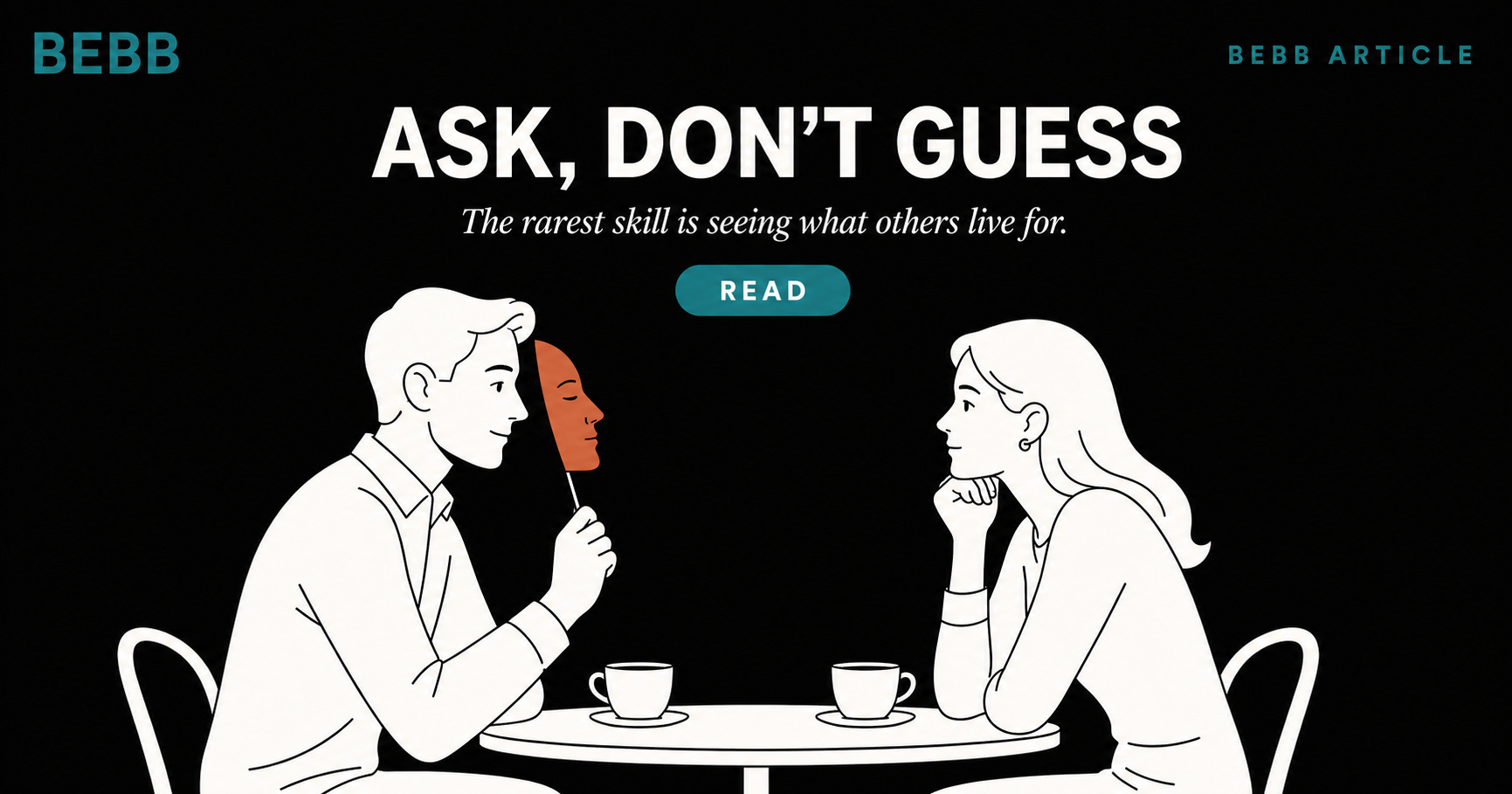
[B2] a mask | something you hold in front of your real self | Maske
[C1] the persona | the social mask you wear to meet what the world expects | die Persona
[C1] individuation | Jung’s word for becoming the person you really are | Individuation
[C1] the will to meaning | Frankl’s idea that the search for meaning drives us most | der Wille zum Sinn
[C1] an allotment | a small rented garden away from your house | Schrebergarten
What Jung and Frankl Were Asking
I put two thinkers in the lesson. The second one quietly ate the first.
Carl Jung gave us the persona. The word is worth a moment: persona was the mask a Roman actor held up on stage. It is the face you put together for work. Jung thought a persona was a perfectly good tool. It only becomes a problem when you forget you are holding it.
In 1933 he wrote that a life has two halves. The first is for building: career, family, house, position. The second is for individuation, his word for slowly becoming who you actually are instead of who your CV says you are. To do that, you have to turn inward.
Viktor Frankl points the other way. He survived the camps and wrote his book in nine days, which is about eight days faster than I manage a newsletter. It came out in German in 1946, and you probably know it as Man’s Search for Meaning.
From it came the will to meaning. Frankl believed our deepest drive is the search for meaning. And you find that meaning by turning outward: towards a task, towards a person, towards the way you carry something you cannot change.
Most people remember Frankl for the suffering. The more useful part of him, on an ordinary Tuesday morning, is where he puts the meaning. He puts it outside you.
Which leads to something that took me ten years of coaching to see properly.
What a person finds meaningful is almost impossible to see from the outside.
The colleague who seems to care only about numbers may be quietly proudest of the junior he is training. The boss whose persona is all ambition may only come alive when you mention his choir. Or his allotment, and his strong views about the neighbours. You will not find that on the org chart. You will certainly not find it in the car park.
You find it by asking. And then by staying quiet long enough to hear the answer.
Ask, don’t guess. That is the whole thing. The rest of this is me trying to earn that sentence.
Key Vocabulary: What the Room Did to the Article
[B2] a bubble | a small group whose opinions feel normal only inside it | Blase, Filterblase
[B2] a means to an end | something you do only in order to get something else | Mittel zum Zweck
[B2] to make a living from something | to earn enough money from it to live | seinen Lebensunterhalt damit verdienen
[B2] a reward | something you get for doing something | Belohnung
[B2] to light up (about something) | to suddenly become animated about a subject | aufleben, strahlen
[C1] to flaunt | to display wealth in a way designed to be noticed | zur Schau stellen, protzen
[C1] to tinker | to work on a machine for pleasure, adjusting and repairing it | herumbasteln, schrauben
What the Room Did to the Article
I expected a polite discussion about bicycles. I got ten sessions of people taking the article apart.
Status has not died. It has gone local. Reinhard, who works in legal tech, put it in one line: “it highly depends on your bubble. In my bubble cars are totally irrelevant, but for other people cars is [sic] the most important thing.” Philipp went straight after the article’s flattering distinction: “I know a couple of guys, friends who have Porsches and they celebrate wealth. It’s the same thinking just with a more expensive hobby.”
Nobody in ten sessions accepted that people had stopped wanting to flaunt things. They accepted only that the objects had changed. That is a much smaller claim.
And what a list of objects it was. Ten sessions produced: holidays. Part-time contracts. An air fryer. A fridge covered edge to edge in travel magnets. A restored espresso machine with a portafilter its owner had repaired himself. Fischertechnik. Sailing. Classic cars. A theatre subscription. A garden. Two sons, offered by a man whose friends have a Porsche 911 and a large house. A grandfather’s empty place in Brandenburg, being renovated one weekend at a time into a retirement plan. One woman described her husband’s Saturday: sourdough in the morning, recumbent bike in the afternoon. The room laughed, because it was literally the article. Another gave hers as not becoming the mother who spends more than forty hours a week at work and never sees her kids. And from a bubble two motorway exits away: G-wagons, parked where the neighbours can see them.
Every one of those is a status symbol to somebody and completely invisible to everybody else.
The sharpest response came from the group with the lowest English level of the week, which is its own quiet lesson. Their English was B1. My German is worse. Ideas do not wait for grammar.
Torsten has owned the same old right-hand-drive Nissan Skyline since he was a teenager. People photograph it at petrol stations. Ask him why he keeps tinkering with it: “it’s a little bit of challenge to drive. A new car is easy, it takes care of you. This is technique, you have to deal with it.”
Then he took the whole article apart in twelve words. His own passion for the car was never a midlife symptom, he said. “It was always there. It just came out of the house.”
Sit with that one, because it’s where the room caught something the newspaper missed.
If the interest was always in the house, then the thing that arrives at forty-five is permission. He has cared about bread quietly for thirty years, in a life with no room in it for bread. The budget shifted, the mortgage eased, the children got older, and what he has now is a free afternoon.
And what he does with that afternoon is go and find out whether it is really his.
That is individuation with a credit card. Jung said the second half of life is for becoming the person you already are, and it turns out that process looks embarrassingly like a middle-aged man buying equipment. The sourdough starter is an experiment. The gravel bike is a hypothesis. Honestly, most of them come back negative: the oven cools down, the jar goes in the bin, he moves on to the next thing, and the neighbours read it as another crisis when it’s really just research.
So the objects are worth looking at after all. They are simply the wrong end of the telescope. You can see the bike in the hallway. You cannot see the question it was bought to answer.
Asked what the real status symbol is today, people in four separate sessions arrived at the same answer: time. Hendrik, who leads a sales team of thirty-seven, said it flatly: “the time, the money, and the freedom to do whatever you want. I don’t have to work anymore.” Natalia described a rich friend who hides it well: “she doesn’t show it. She cut the working hours. Now she’s looking for free time.”
They were right, by the way. A large study across four countries looked at exactly this. People who spend money to buy themselves time are more satisfied with their lives than people who spend it on things.
Fabian went somewhere else again. As a teenager he refused to sell his art, even though his family pushed him: “They say if you can make a living out of your hobby, you never have to work one day in your life. But I would not agree. I think you just lose the hobby.”
Psychology agrees with him. In a famous experiment, one group of children was promised a reward for drawing. Another group was promised nothing. Afterwards, the rewarded children drew about half as much. Pay someone for what they love and you give them a new reason to do it. The old reason quietly disappears.
Rana, who grew up in Syria, asked the sharpest question of the week: “Nobody in Syria goes out and buys a Porsche or a gravel bike at 45. People don’t have this middle age crisis. Maybe people already have an answer for it in religion.” She may well be right. Researchers still argue about whether the midlife dip in happiness happens everywhere.
And one theme came up in almost every session, with almost no argument. Work is a means to an end. Lars is a software developer. Every second weekend he drives elderly and disabled neighbours to the shops and to the doctor. He knows where the weight sits: “The real things which satisfy me are more about interaction with other people, helping other people.”
Then the lesson turned, and stopped being about bicycles at all.
The main speaking task pointed outward. Choose a real person: a colleague, your boss, your most junior teammate. Then give the room ninety seconds on what they find meaningful. What do they actually light up about, and what is your evidence? Six minutes to prepare, alone. No AI, no phone.
It is an uncomfortable little task, and it produced the best speaking I heard all week. It also produced an objection, from the most commercial person I taught this with. Hendrik again: “being able to read other people and know what makes somebody tick. That gives you the angle to sell.” In interviews he watches for the moment a candidate stops performing and starts talking about their gravel bike. Then he follows it. He is describing his job accurately, and I liked him for saying it out loud.
But let’s take his objection seriously, because a fair few readers will feel it too. Maybe all this warm talk about meaning is just sales training with a philosophy degree.
I disagree. Here’s why.
Key Vocabulary: The Art of Reading People
[B2] to make someone tick | to be the thing that drives and motivates a person | jemanden antreiben, ausmachen
[B2] interested vs interesting | wanting to know about others / making others want to know about you | interessiert / interessant
[B2] to take advantage of someone | to use another person for your own benefit | jemanden ausnutzen
[B2] to shut up | (informal) to stop talking | den Mund halten
[C1] to hand someone the floor | to let another person speak, uninterrupted | jemandem das Wort überlassen
[C1] hedging (noun) | softening a claim so that it commits you to less | Relativieren, Abschwächen
[C1] to put someone off (something) | to make them lose interest before they start | abschrecken
The Art of Reading People
The half Scharnigg gets wrong is the funeral. Wealth still shouts, in plenty of bubbles, and a week of German professionals told me so from the inside, cheerfully, with examples.
Jung and Frankl had a bigger question. They were asking what a life is for. Once you ask it that way, the whole status conversation shrinks into what it always was. A pile of clues about people nobody bothered to ask.
Here is the sentence I would keep if I had to burn the rest.
The most important thing about the person across from you is something you cannot see yet.
It sits under the car. Under the title, the certificate on the wall, the carefully written LinkedIn headline. And they would hand it over quite happily. You would only have to ask a decent question and then shut up long enough to hear the answer.
That is Frankl with the philosophy taken off. Costs about four minutes.
This is what I do for a living, and it took me an embarrassingly long time to say out loud. I’m just an expensive speaking partner, really, in the end.
People hire me for English. They get English. But the actual craft is something else. What I do - I get people talking about themselves properly. Past the small talk. The real stuff. I find the thing that makes them tick, the thing that drives them, the thing that lights them up. Then I follow it. And while I’m following it I’m quietly noting the three grammar patterns I’ll hand back at the end.
I know why I got good at it. It is not a flattering story.
I arrived in Germany with a backpack and a saxophone. I couldn’t be charming in German. Couldn’t be quick, couldn’t be funny, couldn’t be clever. Every one of my usual moves was locked behind a door and I didn’t have the vocabulary to open it.
All I had left was questions.
So I asked them. Badly, with the wrong cases. And then I listened, because listening was the only part of the conversation I could do properly.
Twenty years on, my German still falls over in the middle of any bloody sentence with obwohl in it. But I got very good at asking. Very good.
Turns out that was the better skill all along.
Now, the objection. Hendrik is right that this has commercial value. Recruiters do it. Sales leaders do it. Every decent manager alive is doing a version of it. Fine. Let it be useful. Useful things can still be kind.
What we are talking about is the art of conversation, and there is a whole literature on it. Go and look at Dale Carnegie. How to Win Friends and Influence People, 1936, and don’t let the salesman’s title put you off. Underneath it sits something almost nobody acts on. People would rather talk about themselves than about you. And the person who lets them do it gets remembered as a wonderful conversationalist, without saying much at all.
Here is what asking actually does. It hands somebody the floor. It tells them that what they care about matters enough for twenty minutes of another person’s attention. Most adults get that roughly never.
Ask a colleague of fifteen years what they are proudest of. Watch their face. And then keep asking; true interest is in the follow up.
That is a gift to them, not a way to take advantage of them.
Real curiosity and a hunt for the angle can start with the same question. That is why the suspicion exists. They come apart a second later, at the point where you either use what you heard or just enjoy it.
And here is the part I said first, before any of the rest of it, when somebody asked me why I care about this.
It’s enjoyable. Genuinely. A day spent finding out what somebody lights up about beats a day spent being impressive at them.
I have come to think that is the evidence rather than the side-benefit. Frankl’s whole point is that meaning sits outside you: in a task, in a person, in something you are pointed at. Enjoyment runs on the same wiring. The people who find other people boring are usually the ones who never asked them anything. Turn outward and you get both at once. Same mechanism, both times.
So let me say the strong version, with no hedging, because this gets filed under soft skills and waved away. It is not soft-school bullshit. It is one of the most important skills a person can possess. And more people should be working on it. More people definitely need to work on it.
We spend fortunes on being interesting. We spend almost nothing on being interested.
One honest thing to finish.
I have been running a topic a week for a long time. Some land. Some don’t. This one landed in every single room, which almost never happens, and two groups asked to carry on with it next week.
What I wasn’t expecting was what it did to me. I taught the same task ten times. I watched people describe colleagues they had sat beside for a decade, then work out how much of it they had been guessing. And somewhere in there I noticed what my own job actually is.
Nineteen years I’ve been calling it English coaching.
When did you last ask somebody what really makes them tick - and then stay quiet long enough to find out?
Your Move
Skip the vocabulary drill this week. The task is a conversation, and it is a small one.
Pick one colleague. Someone you have worked with long enough that you assume you know them. Ask them one real question in English about something outside the job description. What are they proudest of? What is the photo on their desk actually of?
Then follow one rule, and this is the hard part. Do not steer for ninety seconds. No redirecting. No “that reminds me of when I”. No sitting there with your own story ready to go, like a man waiting for a gap in the traffic.
Your grammar will wobble the moment you get genuinely interested in the answer, because attention and accuracy fight for the same brain. Good. That’s acquisition doing its job.
Two things happen. Your English gets a workout one step above what you can comfortably do, which is exactly where acquisition lives. And somebody at your company has a better Tuesday than they were expecting.
This came out of a week of teaching the same question across ten sessions. Two things are published alongside it. If you want to practise the language in this piece on your own, the self-study version is four prompts you paste into any AI, free and with no sign-up. If you teach, the companion three-level lesson has the reading, the vocabulary and the full discussion task at B1, B2 and C1, and the notes on how to run it are at the bottom.
The speaking task described above is step three of what I call The BEBB Method — The Agency Loop, a five-step framework for using AI in language learning without letting it replace your own thinking. It is my own configuration of established best practices in human-AI collaboration, built in direct response to Gerlich (2025) on cognitive offloading, and informed by the “AI Sandwich” tradition (Ippolito, 2023) and “AI as Critic” scaffolding (Mollick, 2024). All names and companies in this piece have been changed.