Lesson: Climate Rollback — Three Honest Positions on a Contested Decade
A free editorial English lesson at three levels (B1, B2, C1) — for learners and teachers

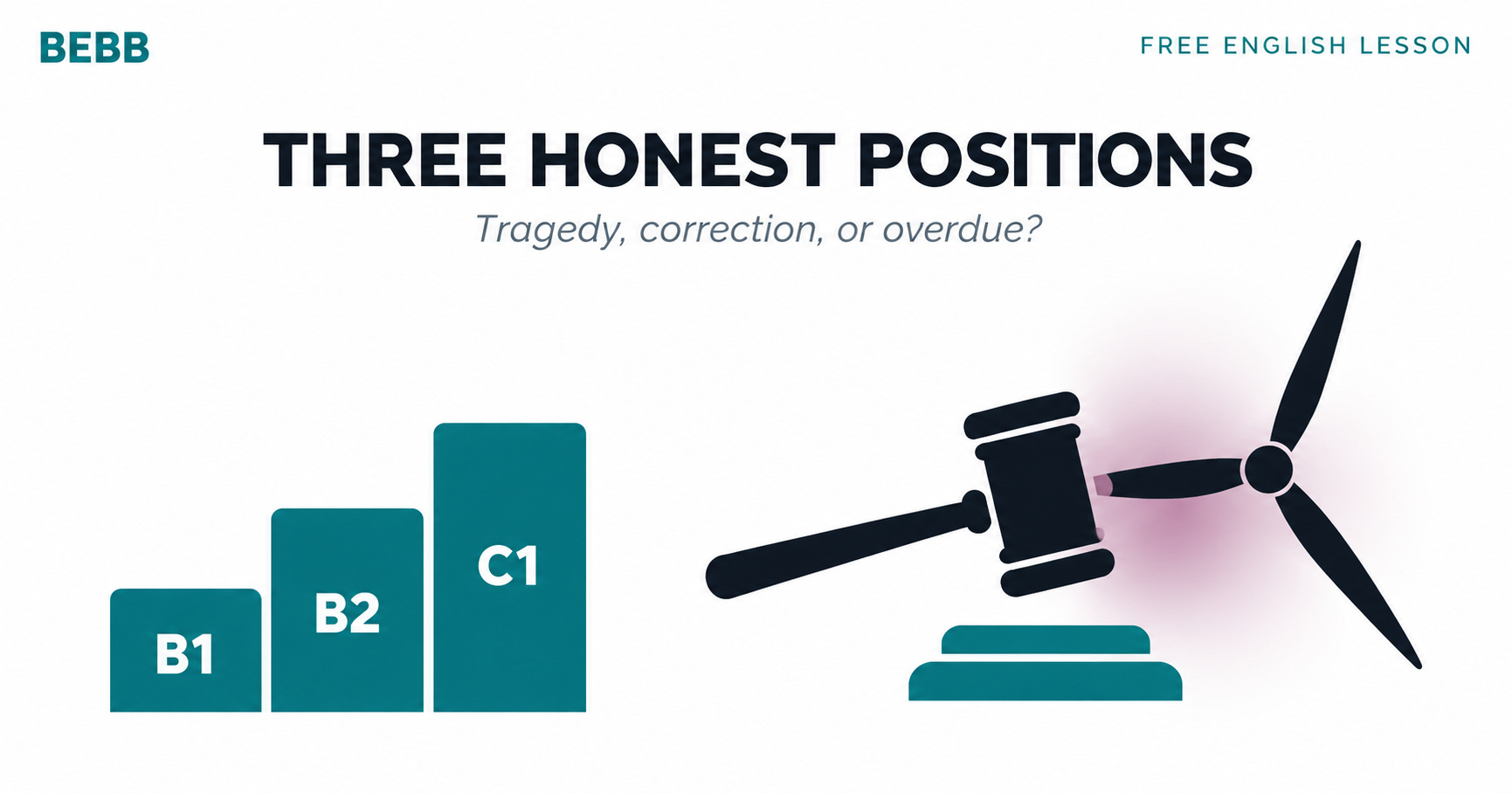
Across 2024 to 2026, something unusual happened. The Hague Court of Appeal reversed the famous 2021 Shell ruling. The German Bundesgerichtshof dismissed the Deutsche Umwelthilfe lawsuits against BMW and Mercedes-Benz. The US Supreme Court ruled unanimously for Chevron. The Swiss parliament refused to comply with a binding European Court of Human Rights judgment. The German Klimaschutzgesetz was quietly reformed. Three honest positions exist on whether this rollback is a tragedy, a constitutional correction, or an overdue end to a strategy that was wrong from the start. In this lesson, you will read all three — and then defend the one you draw at random, even if it is not the one you personally hold.
This lesson is published in three CEFR levels so you can pick the one that fits your group:
👉 B1 version — Three honest views on the climate court rulings (≈ 330-word reading, simpler grammar, concrete questions)
👉 B2 version — Three positions on a contested decade (≈ 460-word reading, moderate complexity)
👉 C1 version — Climate Rollback: Tragedy, Correction, or Overdue? (full editorial readings, three positions verbatim, advanced argumentation)
👉 About the BEBB Method — The Agency Loop (the AI scaffolding embedded in this lesson)
👉 For teachers — how to run this in 60 to 90 minutes, what to cut, what to protect
Every version uses the same topic, the same six landmark cases, and the same three-position structure — only the linguistic complexity, the depth of the readings, and the number of task cycles change. You can run this with one group at one level, or use it as a bridge across mixed levels.
If you want the full author’s take on why this topic matters and where it is heading, read the companion article: [Forcing Doesn’t Work. Showing Does. — link].
About The BEBB Method — The Agency Loop
Every lesson I publish uses an AI scaffolding approach I call The BEBB Method — The Agency Loop, a five-step framework for using AI in language learning without letting it replace your own thinking. It is my own configuration of established best practices in human-AI collaboration, built in direct response to Gerlich (2025) on cognitive offloading, and informed by the “AI Sandwich” tradition (Ippolito, 2023) and “AI as Critic” scaffolding (Mollick, 2024).
Agency = your own capacity to decide, think, and act. In this method, you keep your agency at every step — you, not the AI, remain the one deciding what happens to your thinking.
The five steps are:
Think first (no AI). Write down what you already know or believe. Anchor your own position before any input.
Use AI for facts. Lookup, not generation. Numbers, dates, definitions — not arguments.
Draft yourself. Your own writing, in your own words, using what you know plus what you have looked up.
Challenge with AI. Ask for the strongest counter-argument, not approval. Do not ask “are you sure?” — that produces flattery.
Combine. Revise into your own final position. Engage with the criticism. Your final version is yours, sharpened.
How the method is delivered in this lesson:
B1: Two task cycles (Task 1 + Task 3 — think first → AI challenge). The middle “draft yourself” step is dropped because cognitive load competes with language load at this level.
B2: Two cycles by default, with the middle “draft yourself” cycle (Task 2) offered as optional for groups with strong fluency and time on the clock.
C1: Three full task cycles (Task 1 + Task 2 + Task 3 — think first → draft yourself → challenge with AI from the other two positions).
The method is the same. The delivery scales by level. Other teachers — feel free to adapt this to your own contexts. If you do, I would love to hear how it lands.
For teachers
This lesson was originally built for a C1 90-minute editorial format and then adapted down for B2 and B1 60-minute groups. The topic is unusually contested — the lesson works only if the trainer holds genuine neutrality across the three positions and does not close with reassurance about what climate change “really is.” Honest closing: the warming is real AND the policy response has been more contested than we have been told AND reasonable people genuinely disagree on whether the rollback is a tragedy, a correction, or overdue.
Suggested format: 60 minutes per level for B1 and B2; 90 minutes for C1. The reading is the anchor; the assigned-position debate is where the value lives. Don’t rush the discussion to finish the activities — better to cut a comprehension question than to lose the conversation.
Key advice:
Trainer neutrality is non-negotiable. Across the lesson sequence, students must not be able to tell which position you hold. Some will assume Position A by default — German educator bias. Calibration is correct when both Position-A-leaning and Position-C-leaning students feel slightly uncomfortable but neither feels silenced.
Random binding card draw is the mechanism. Do NOT let students pick. The cognitive value of the lesson is in defending a position one does not naturally hold. If a student strongly resists their assigned position, acknowledge (”I see this is hard”) and stay with the assignment. Refusing to defend is itself the strawmanning instinct.
Position C deserves the same airtime as A and B. If you find yourself spending less time on Reading C, more time interrupting Position-C presenters, or more time recasting their language, that is a calibration problem to address, not a quality intervention.
The micro-research warm-up is the engine of the lesson. Each participant is assigned one of six landmark legal cases (Klimabeschluss, KSG reform, Hague reversal of Shell, KlimaSeniorinnen, Chevron-Plaquemines, BGH BMW/Mercedes) to research using the Three-Prompt Pattern, then present back. Do not skip this.
Do not close with “but of course climate change is real.” That ending makes Position-C-leaning students disengage and confirms the bias your neutrality is trying to suppress.
Suggested 60-minute timing (B1 / B2)
Warm-up — micro-research (Three-Prompt Pattern) — 12 min
Vocabulary activity — 6 min
Task 1 — Anchor your honest opinion (no AI) — 5 min
Reading (silent + clarification) — 10 min
Comprehension check — 5 min
Task 3 — Challenge with AI + revise — 10 min
Discussion — 10 min
Wrap-up / one takeaway each — 2 min
Suggested 90-minute timing (C1)
Warm-up — micro-research + position card draw — 15 min
Vocabulary activity — 10 min
Task 1 — Anchor your honest opinion (no AI) — 6 min
Reading — jigsaw (your position deeply + two summaries) — 8 min
Task 2 — Build and teach your position to the room (no AI) — 18 min
Comprehension check — 8 min
Task 3 — AI stress-test from the OTHER two positions + revise — 10 min
Discussion — 13 min
Wrap-up — 2 min
The reading is structured as a jigsaw: you read your assigned position in full, and the other two as 100-word summaries. The room only receives the other positions through the spoken share-back in Task 2 — which is why Task 2 expands and Task 1’s reading shrinks. More speaking time, less silent reading time, the same intellectual load.
If you only have 45 minutes: cut the vocabulary activity, run Task 1 in 3 minutes, push Task 3 entirely to homework, and shorten discussion. The micro-research warm-up is still essential. The arc still completes through the homework.
B1 version
Warm-up — Micro-Research Task (12 min)
Six big legal decisions in 2024–2026 changed how courts handle climate cases. Your trainer will give you ONE to research, then you will present back to the group in 90 seconds.
The six items (your trainer will assign one — items 1 to 3 are core, items 4 to 6 are stretch):
(Core) The German Constitutional Court’s 2021 climate decision (in German: Klimabeschluss)
(Core) The 2024 reform of the German Climate Protection Law (Klimaschutzgesetz)
(Core) The Dutch court’s 2024 decision in the Shell case (in Dutch: Milieudefensie v. Shell)
(Stretch) The Swiss climate-grandmothers case at the European Court of Human Rights, April 2024 (KlimaSeniorinnen), and the Swiss parliament’s refusal to follow it
(Stretch) The US Supreme Court Chevron ruling, April 2026 (Chevron-Plaquemines)
(Stretch) Germany’s highest civil court ruling on BMW and Mercedes-Benz, 23 March 2026 (Bundesgerichtshof / BGH)
Lookup questions to bring back to the group:
What did the court (or parliament) decide, and when?
What was the main reason?
Why does this case matter for the bigger story?
✦ Before you research — Agency Loop Step 1: Take 1 minute. Write down 2 or 3 things you already know or believe about your assigned case. Just keywords. This is your starting point — your own thinking comes first.
Now use the three prompts in sequence with your AI tool. Substitute your assigned item into Prompt 1.
Prompt 1 — Research
LEVEL: B1
LESSON TOPIC: 2024–2026 court decisions about climate change
MY ITEM: [YOUR ASSIGNED ITEM]

In a 3-sentence summary at LEVEL register: tell me about MY ITEM.
Cover what it is, the key fact or example that makes it specific,
and why it matters in the context of LESSON TOPIC.

Plain English at the level above. Define any technical term in
8 words or less. No vocabulary above the level above.
Prompt 2 — Language Menu
Now give me a language menu I can use when I talk about this in
English at the same level.

Produce 6 useful phrases that I can reuse when I present this to
my group. For each phrase, give me three things in this format:

1. **The phrase in English** (in bold)
   [Short German contextual translation in square brackets — what
   a German speaker would actually say, NOT a literal word-for-word.
   E.g. *to address something* → [etwas angehen, nicht: adressieren].]
   "One example sentence using the phrase, at LEVEL register, in
   double quotes."

Use a numbered list. Leave a blank line between each item so I can
read them fast.
Prompt 3 — Present
Now help me present this to my group.

Use the research from Prompt 1 and the language menu from Prompt 2.
Produce a 90-second mini-talk at the same level that:

1. Opens with one strong, short sentence.
2. Delivers the content in 3–4 short paragraphs.
3. **Bolds every phrase from the language menu** the moment it
   appears in the talk, so I can see where the menu language is
   being reused. Use at least 4 of the 6 menu phrases.
4. Closes with one sentence that lands the point.

Spoken-English rhythm: short sentences, contractions where natural,
conversational connectors (so, then, here's the thing, what this
means is). No jargon above the level above. Total output under
100 words.
Timing: 4–5 min individual research, 1–2 min per student presenting.
Vocabulary (B1) — match the words to the definitions
Match the words and phrases (1–8) with the definitions (A–H).
a court
to decide
a law
urgent
to protect
to disagree
to balance two things
to change your mind
A. a place where judges listen to a case and make a decision
B. to make a final choice, often after thinking carefully
C. a written rule made by a parliament that everyone in a country must follow
D. so important that you must do it now, not later
E. to keep something or someone safe from harm
F. to think differently from someone else; to not agree
G. to give fair weight to two different things at the same time
H. to start to think differently about something after you had a different opinion
TASK 1 (B1) — Map Your Starting Position
This is the first step of The Agency Loop (dt. etwa: Handlungsfähigkeit im Umgang mit KI — du bleibst die Entscheider·in). Anchor your own thinking before the reading.
Step 1 — Alone (3 min): Without using any tool, write 4 to 6 short keywords that show your answer to this question:
In 2024–2026, many courts said NO to big climate cases. Is this good news or bad news?
Just keywords. Not full sentences. No AI, no Google.
Step 2 — In pairs (2 min): Tell your partner your keywords and why you chose them. Try to use 2 of the new vocabulary words. Your partner asks you one short question.
Keep your keywords. You will need them later.
Reading (B1): Three honest views on the climate court rulings
(1) In 2024, 2025 and 2026, something surprising happened. Many big courts in Europe and the United States said NO to climate cases that climate groups had won before. In the Netherlands, the higher court changed the famous Shell decision — Shell does not have to cut its CO2 by 45% any more. In Germany, the highest civil court (the BGH) said NO to the lawsuits against BMW and Mercedes-Benz. In the United States, all nine judges of the Supreme Court agreed: Chevron does not have to pay. In Switzerland, the parliament refused to follow a European court decision. People disagree strongly about what this means. There are three honest views.
(2) View A — This is a tragedy. A famous lawyer, Roda Verheyen, says the courts are giving up. She says the climate is in danger and these decisions make it worse. Big companies have a lot of money and a lot of lawyers, and now they are winning again. The climate movement must continue to fight. The Constitutional Court’s 2021 decision (the Klimabeschluss) said we must protect freedom for future generations. We cannot stop now.
(3) View B — This is a correction. Other lawyers, like Professor Matthias Ruffert, say something different. They say climate policy is very important — but it should be made by parliaments, not by courts. Courts cannot decide everything. In paragraph 47 of its decision, the BGH said: “Only the parliament can decide how to share emissions between different industries.” This is not climate denial. This is the courts saying: this is a job for politicians, not for judges.
(4) View C — This is overdue. A third group of voices says something stronger. They include Bjørn Lomborg and Steven Koonin (a former US Energy official under Obama). They say the climate IS changing — but our reaction has been too extreme. Global CO2 went UP from 35.2 gigatonnes in 2015 to 38.4 gigatonnes in 2025. So the legal fight did not work. Worse: when Germany closed factories because of high electricity prices, those factories moved to China and India — where CO2 is even higher. The German energy expert Fritz Vahrenholt says: “The energy transition has hit a wall.”
(5) Three positions. All three say something true. Which one do you find most honest? Be careful — the most honest one is sometimes the one we least want to hear.
(≈ 350 words)
Comprehension questions (B1)
Name two court decisions from 2024–2026 mentioned in the reading. (Paragraph 1)
According to View A, why must the climate movement continue to fight? (Paragraph 2)
What did paragraph 47 of the BGH decision say, and what does this mean for View B? (Paragraph 3)
According to View C, what happened to global CO2 between 2015 and 2025? (Paragraph 4)
According to View C, what happens when Germany closes factories because of high electricity prices? (Paragraph 4)
TASK 3 (B1) — Challenge With AI
This is steps 4 and 5 of The Agency Loop. Use AI to test your thinking, then write a final answer that is yours.
Step 1 — Alone (3 min): Look at your keywords from Task 1. Now answer this question in 3 to 5 short sentences:
In 2024–2026, many courts said NO to climate cases. Is this good news or bad news? Why?
Use the reading to support your idea. Do not use AI yet.
Step 2 — Challenge with AI (3 min): Open an AI tool. Paste your answer. Use this prompt:
“Read my short answer about court decisions on climate change. Please tell me, in simple English: (1) What is one strong argument AGAINST my view? (2) What is one important fact I am missing? Give your answer in short, easy sentences.”
⚠ Do NOT ask the AI “are you sure?” That makes the AI say YES and repeat itself. Ask for the strongest counter-argument instead. This is how you keep your agency.
Step 3 — Final version (4 min): Rewrite your answer in 3 to 5 sentences. You can keep your original idea, or change it. But you must use one new fact or one new idea from the AI’s response. Then read your final answer to your partner.
Discussion (B1)
Have you ever changed your mind about a big decision after reading more information? What changed your mind?
Who do you trust most to make important decisions about the climate — politicians, judges, scientists, or someone else? Why?
In your country, do people talk a lot about climate change? Do they agree or disagree about what to do?
The reading says it is hard to listen to the position you do not agree with. Have you noticed this in your own life?
If your country had to pay much more for electricity, would your family or your company change anything? What?
Homework (B1) — “The Other Side”
This homework finishes today’s lesson at home and completes The Agency Loop.
Your task: Write 5 to 8 simple sentences OR record a 60-second voice note about ONE view from the reading that you do NOT agree with.
Questions to answer:
Which view (A, B, or C) is hardest for you to agree with?
Why is it hard to agree with?
Now try to write the strongest reason FOR that view. (Yes — for the view you don’t like!)
After writing the strongest reason, did your opinion change a little, or stay the same?
Sentence starters (use them):
The view I find hardest is ________ because ________.
But the strongest reason for this view is ________.
After thinking about this, my opinion ________ (changed / stayed the same).
Model answer (an example — do not copy, write your own):
The view I find hardest is View C, because it sounds like the climate is not so important. But the strongest reason for this view is the numbers — global CO2 went UP, not down, even with all the court cases. So maybe the strategy was wrong. After thinking about this, my opinion changed a little. I still think we must do something. But I now agree that we must check if our actions really work.
How to submit: Send me your sentences or voice note by Tuesday morning (WhatsApp is fine). We will read some of them together at the start of our next lesson.
B2 version
Warm-up — Micro-Research Task (12 min)
Across 2024 to 2026, six landmark legal decisions changed the climate-litigation landscape in Germany, the Netherlands, the United States and Switzerland. Your trainer will assign you ONE to research and present back to the group in 90 seconds.
The six items (your trainer will assign one — items 1 to 3 are core, items 4 to 6 are stretch):
(Core) The Bundesverfassungsgericht Klimabeschluss (March 2021) — the German Constitutional Court’s landmark climate decision
(Core) The 2024 reform of the Klimaschutzgesetz — the German Climate Protection Law
(Core) The Hague Court of Appeal reversal of Milieudefensie v. Shell (November 2024)
(Stretch) KlimaSeniorinnen v. Switzerland at the European Court of Human Rights (April 2024) and the Swiss parliamentary rejection
(Stretch) Chevron-Plaquemines at the US Supreme Court (April 2026)
(Stretch) The BGH ruling on BMW and Mercedes-Benz (23 March 2026)
Lookup questions:
What did the court (or legislature) decide, and when?
What was the key reasoning?
Why does this case matter to the broader rollback story?
✦ Before you research — Agency Loop Step 1: Take 1 minute. Write down 2–3 things you already know or believe about your assigned case. Just keywords.
Now use the three prompts in sequence with your AI tool.
Prompt 1 — Research
LEVEL: B2
LESSON TOPIC: the 2024–2026 rollback of climate litigation across
Germany, the Netherlands, the US and Switzerland
MY ITEM: [YOUR ASSIGNED ITEM]

In a 3-sentence summary at LEVEL register: tell me about MY ITEM.
Cover what it is, the key fact or example that makes it specific,
and why it matters in the context of LESSON TOPIC.

Plain English at the level above. Define any technical term in
8 words or less. No vocabulary above the level above.
Prompt 2 — Language Menu
Now give me a language menu I can use when I talk about this in
English at the same level.

Produce 6 useful phrases that I can reuse when I present this to
my group. For each phrase, give me three things in this format:

1. **The phrase in English** (in bold)
   [Short German contextual translation in square brackets — what
   a German speaker would actually say, NOT a literal word-for-word.
   E.g. *to address something* → [etwas angehen, nicht: adressieren].]
   "One example sentence using the phrase, at LEVEL register, in
   double quotes."

Use a numbered list. Leave a blank line between each item so I can
read them fast.
Prompt 3 — Present
Now help me present this to my group.

Use the research from Prompt 1 and the language menu from Prompt 2.
Produce a 90-second mini-talk at the same level that:

1. Opens with one strong, short sentence.
2. Delivers the content in 3–4 short paragraphs.
3. **Bolds every phrase from the language menu** the moment it
   appears in the talk, so I can see where the menu language is
   being reused. Use at least 4 of the 6 menu phrases.
4. Closes with one sentence that lands the point.

Spoken-English rhythm: short sentences, contractions where natural,
conversational connectors (so, then, here's the thing, what this
means is). No jargon above the level above. Total output under
150 words.
Vocabulary (B2) — match the words to the definitions
Match the words and phrases (1–10) with the definitions (A–J).
to overturn (a ruling)
to uphold (a ruling)
to dismiss (a case)
plaintiffs vs. defendants
to enforce
to consult / to disagree
the legislature vs. the court
urgent / urgency
to balance two interests
proportionality
A. to officially reverse a previous court decision so that it is no longer legally binding
B. to confirm that a previous court decision was correct, leaving it in force
C. to refuse to hear a case, or to end a case without a full trial on the merits
D. the people who bring a lawsuit (in German Kläger) versus the people the lawsuit is brought against (in German Beklagte)
E. to put a law or regulation into practical effect — to make sure it is actually followed
F. to seek the views of relevant parties (consult), or to hold an opposing view (disagree); both are common in legal and political reasoning
G. the parliament that writes the laws versus the court that interprets and applies them — two separate branches of democratic power
H. needing immediate action (adjective); the noun form describes the quality of needing action without delay
I. to give fair weight to two competing concerns at the same time — for example, climate protection and economic stability
J. the legal principle that the means used to reach a goal must not exceed what is necessary — central to German constitutional law
TASK 1 (B2) — Anchor Your Own View (5 min)
This is the first step of The Agency Loop (dt. etwa: Handlungsfähigkeit im Umgang mit KI — du bleibst die Entscheider·in). Think for yourself first, before the reading and before any AI.
Step 1 — Alone (3 min): Write 5 to 7 keywords answering this question. No AI, no searching.
Across 2024–2026, many courts and parliaments REVERSED earlier climate-law victories. Is this rollback a tragedy, a constitutional correction, or overdue?
Just keywords. Your honest first reaction.
Step 2 — In pairs (2 min): Share your keywords with your partner. Try to use 3 of the new vocabulary items. Your partner asks you one follow-up question. Keep your notes — you will need them in Task 3.
Reading (B2): Three positions on a contested decade
(1) Across 2024 to 2026, a remarkable pattern emerged in climate litigation. The Hague Court of Appeal overturned the famous 2021 Shell ruling, finding that no specific emissions reduction could be imposed on a single company without a binding sector-wide standard. The German Bundesgerichtshof (BGH) dismissed the Deutsche Umwelthilfe lawsuits against BMW and Mercedes-Benz on 23 March 2026. The US Supreme Court ruled unanimously for Chevron in Chevron-Plaquemines, removing the federal court pathway for most climate-tort cases. The Swiss parliament formally rejected a binding European Court of Human Rights judgment. And the German Klimaschutzgesetz was quietly reformed in 2024, removing the year-by-year sector-specific binding emissions targets that the 2021 Constitutional Court ruling (Klimabeschluss) had effectively required. Three honest positions exist on what this rollback means.
(2) Position A — This is a tragedy. Movement-aligned lawyers like Roda Verheyen argue that the rollback is what political capture looks like when it is well-resourced and patient. The legal infrastructure that took a decade to build is being dismantled in eighteen months. The 2021 Klimabeschluss recognised the rights of future generations — a duty to balance present economic interests against the freedom of those who will live with the consequences. Courts that now decline to enforce that duty are not being neutral. They are choosing, by inaction, who pays the cost of delay. The strategy must evolve, but the legal fight cannot end.
(3) Position B — This is a constitutional correction. Constitutional law professors like Matthias Ruffert argue that the 23 March 2026 BGH ruling is institutional self-restraint, not climate denial. In paragraph 47, the senate held: “The legislative process is the only appropriate forum for the allocation of emissions budgets among economic sectors.” The court did not say climate change was unimportant. It identified the limits of its institutional competence and declined to exceed them. Movement lawyers, on this reading, had spent years treating the Klimabeschluss as if it required any specific litigation outcome they could imagine. It did not. Climate policy belongs in parliaments. That is harder, slower, and more politically contingent than litigation — but in a constitutional democracy, it is the only place it can finally be made to last.
(4) Position C — This is overdue. A different group of voices — including Bjørn Lomborg, Steven Koonin (former Under-Secretary of Energy under Obama) and the German energy expert Fritz Vahrenholt — argue that the activist legal-policy strategy was disproportionate from the start. Global CO2 emissions ROSE from 35.2 gigatonnes in 2015 to 38.4 gigatonnes in 2025 — a roughly 5% increase across the entire activist-litigation decade. When German industrial production migrates to China and India because of high electricity prices, the displaced production has higher carbon intensity, not lower. Vahrenholt’s framing in German is direct: “Die Energiewende ist gegen die Wand gefahren” — the energy transition has hit a wall. This is not climate denial. It is proportionality criticism. The rollback, on this view, is democratic institutions correcting a decade of overreach.
(5) Three positions. All three contain real evidence. The discomfort of the lesson is that the most honest position may not be the one you expected to defend.
(≈ 480 words)
TASK 2 (B2) — Draft Your Own Answer (optional — do this if you have time)
This is the third step of The Agency Loop — write your own view before testing it against AI. Skip this task if time is tight.
Step 1 — Alone (5 min): Write 5 to 7 sentences answering this question in your own words:
Of the three positions, which one do you find most honest after reading? Why?
Use at least 3 vocabulary items. No AI. This is YOUR opinion.
Sentence starters if you need them:
The position I find most honest is ________ because…
I take the point that ________, but where I would push back is…
The strongest evidence for this position is…
If I had to argue the opposite, the hardest fact to ignore would be…
Step 2 — In pairs (3 min): Read your draft to your partner. Your partner tells you one sentence that was strong and one that was unclear. Keep your draft for Task 3.
Comprehension questions (B2)
Name three of the five 2024–2026 court or parliamentary actions described in paragraph 1 of the reading.
According to Position A (paragraph 2), what did the 2021 Klimabeschluss recognise, and how does Position A characterise courts that now decline to enforce it?
What is the “paragraph 47 line” from the BGH ruling, and why does Position B treat it as institutional self-restraint rather than climate denial? (Paragraph 3)
What did global CO2 emissions do between 2015 and 2025, according to Position C, and why does Position C treat industrial migration to China and India as evidence against the activist legal strategy? (Paragraph 4)
The reading ends by saying “the most honest position may not be the one you expected to defend.” What does this sentence tell you about the lesson’s design? (Paragraph 5)
TASK 3 (B2) — Challenge With AI and Revise (10 min)
This is steps 4 and 5 of The Agency Loop.
Step 1 — Alone (3 min): If you did Task 2, take your draft. If you skipped Task 2, write 5 to 7 sentences now answering: “Of the three positions, which one do you find most honest after reading? Why?” Use your notes from Task 1 and the reading. Write YOUR honest opinion.
Step 2 — Challenge with AI (4 min): Open an AI tool. Paste your draft with this prompt:
“Read my short text about three positions on the 2024–2026 climate-litigation rollback. Please give me, in clear English at B2 level: (1) The strongest counter-argument from each of the OTHER two positions I did NOT choose. (2) One important fact I appear to be ignoring. Be precise and concessive — the strongest counter, not the easiest one.”
⚠ Do NOT ask the AI “are you sure?” That question produces flattery and re-assertion of your view. The “strongest counter from the other two positions” framing is the right stress-test. Read the response. Underline one point you agree with and one you disagree with.
Step 3 — Revise (3 min): Rewrite your draft in 5 to 7 sentences. You can keep your original opinion — but you must engage with at least one of the counter-points. You are not changing sides automatically. You are sharpening your own reasoning.
If you run out of time: finish Step 3 at home. See the homework section.
Discussion (B2)
Have you ever held a strong opinion and then changed it after reading the strongest version of the opposite case? What happened?
The reading says climate policy “belongs in parliaments, not in courts.” In your country, where do most big policy decisions get made — in parliament, in court, or somewhere else?
Position C says global CO2 ROSE during the activist-litigation decade. Does that fact change how you think about the legal strategy? Why or why not?
Many German companies (BASF in Ludwigshafen is the famous example) are moving production to countries with cheaper electricity. Have you seen this in your own industry?
The trainer is asked to stay neutral across the three positions. Do you think the trainer SHOULD stay neutral on a topic like this — or is neutrality itself a position?
After reading all three, which position do you find HARDEST to take seriously, and why?
Homework (B2) — “Steelman the Other Side”
This homework completes The Agency Loop asynchronously. If Task 3 was squeezed in class, this is where you finish it properly.
Your task: Write a paragraph of 150 to 200 words (or record a 2-minute voice note) answering this prompt:
Choose the position (A, B, or C) you found HARDEST to take seriously. Now write the STRONGEST possible case FOR that position — as if you were trying to convince an intelligent friend who already holds it.
Use steelmanning vocabulary (the strongest version of this argument is…, I take the point that…, where I would push back, but I see why you would hold X…).
Sentence starters:
The position I find hardest is ________ because ________.
But the strongest version of this argument is ________.
The most uncomfortable fact for my own view is ________.
After writing this steelman, my opinion has ________ (shifted slightly / stayed the same / become more nuanced) because ________.
Why this homework: if you cannot make a case that would convince an intelligent person who already holds the view, you have strawmanned the position somewhere. Go back to the reading and find the strongest version. Both the language goal (steelmanning vocabulary) and the substantive goal (taking the other side seriously) are completed asynchronously.
How to submit: Send me your paragraph (or voice note) by Tuesday morning — WhatsApp or email is fine. We will open the next lesson by reading some of them aloud.
C1 version
Warm-up — Micro-Research Task (15 min)
Activity A — Micro-Research (12 min)
Six landmark legal cases shape the 2024–2026 climate-litigation rollback. You will be assigned ONE to research, then present back to the group in 90 seconds.
The six items (your trainer will assign one — items 1 to 3 are core, items 4 to 6 are stretch):
(Core) The Bundesverfassungsgericht Klimabeschluss (March 2021)
(Core) The 2024 reform of the German Klimaschutzgesetz
(Core) The Hague Court of Appeal reversal of Milieudefensie v. Shell (November 2024)
(Stretch) KlimaSeniorinnen v. Switzerland at the European Court of Human Rights (April 2024) and the Swiss parliamentary rejection
(Stretch) Chevron-Plaquemines at the US Supreme Court (April 2026), with Shell v. McColl context
(Stretch) The BGH ruling on BMW and Mercedes-Benz (23 March 2026)
Lookup questions to bring back to the group:
What did the court (or legislature) decide, and when?
What was the key reasoning or trigger?
Why does this case matter to the broader rollback story?
(Umbrella) Where does this case sit on the tragedy / correction / overdue spectrum?
✦ Before you research — Agency Loop Step 1: Take 1 minute and write down 2–3 things you already know or believe about your assigned case. Just keywords. This is your starting point — your own thinking comes first.
Now use the three prompts in sequence with your AI tool. Substitute your assigned item into Prompt 1.
Prompt 1 — Research
LEVEL: C1
LESSON TOPIC: the 2024–2026 rollback of climate litigation across
Germany, the Netherlands, the US and Switzerland
MY ITEM: [YOUR ASSIGNED ITEM]

In a 3-sentence summary at LEVEL register: tell me about MY ITEM.
Cover what it is, the key fact or example that makes it specific,
and why it matters in the context of LESSON TOPIC.

Plain English at the level above. Define any technical term in
8 words or less. No vocabulary above the level above.
Prompt 2 — Language Menu
Now give me a language menu I can use when I talk about this in
English at the same level.

Produce 6 useful phrases that I can reuse when I present this to
my group. For each phrase, give me three things in this format:

1. **The phrase in English** (in bold)
   [Short German contextual translation in square brackets — what
   a German speaker would actually say, NOT a literal word-for-word.
   E.g. *to address something* → [etwas angehen, nicht: adressieren].]
   "One example sentence using the phrase, at LEVEL register, in
   double quotes."

Use a numbered list. Leave a blank line between each item so I can
read them fast.
Prompt 3 — Present
Now help me present this to my group.

Use the research from Prompt 1 and the language menu from Prompt 2.
Produce a 90-second mini-talk at the same level that:

1. Opens with one strong, short sentence.
2. Delivers the content in 3–4 short paragraphs.
3. **Bolds every phrase from the language menu** the moment it
   appears in the talk, so I can see where the menu language is
   being reused. Use at least 4 of the 6 menu phrases.
4. Closes with one sentence that lands the point.

Spoken-English rhythm: short sentences, contractions where natural,
conversational connectors (so, then, here's the thing, what this
means is). No jargon above the level above. Total output under
200 words.
Activity B — Position Assignment (3 min)
The trainer has a deck of nine cards: three A’s, three B’s, three C’s. Draw one. The position you draw is the one you will defend in Task 2 — regardless of what you personally believe. You may agree, disagree, or feel uncertain about it. That is the point.
The three positions, briefly:
Position A — Tragedy. The 2024–2026 rollback is political capture by industry. The climate movement must continue the legal fight.
Position B — Correction. The legal system found its proper limits. Climate policy belongs in parliaments, not in courts.
Position C — Overdue. The activist legal-policy strategy was disproportionate from the start. The rollback is democratic institutions correcting a decade of overreach.
Hold your card. We come back to it.
Vocabulary (C1) — match the words to the definitions
✦ Agency Loop — guess from context first: Try to guess the meaning of each item from the word itself or from what you already know. Write your best guess next to each item. Then do the matching exercise to check.
Match each word or phrase (1–12) with its definition (A–L).
to hold (a court holds)
to decline to / to stop short of
while accepting that X, the court declined to Y
might be read as / could plausibly / would arguably
to overturn vs. to overrule vs. to reverse vs. to remand vs. to uphold vs. to affirm
to enforce vs. to apply vs. to interpret vs. to construe
plaintiffs / defendants / appellants / respondents / petitioners
intertemporale Freiheitssicherung
the strongest version of X argues / the most charitable reading is
I take the point, but / where I would push back is
this is not strictly X-or-Y — it is more about Z
to be (geo)politically weaponised
A. A spectrum of reporting verbs used to describe what a court said. Each has a slightly different force: to find (factual), to hold (legal conclusion), to rule (formal disposition), to acknowledge (concede a point).
B. Verbs of formal court output. To decline something is to refuse a step the parties asked for; to stop short of a step is to refuse it but signal the question is still open.
C. A concessive construction acknowledging one premise while withholding agreement on another — a key C1 move in disagreeing without dismissing.
D. Distancing modal phrases that hedge a claim. They signal that the speaker is offering a reading rather than asserting a fact — central to C1 institutional discourse.
E. Verbs used when a higher court touches a lower court’s decision: to reverse the outcome, to overturn the precedent itself, to remand the case back for further proceedings, or to uphold / to affirm the lower decision. All collapse to aufheben / bestätigen in German.
F. A cluster of verbs about what courts and regulators do with law: putting it into effect, applying it to a case, reading what it means, or giving it a particular meaning. All collapse to anwenden / auslegen in German.
G. A spectrum of legal actors across instances — first-instance claimants, the people sued, those who file appeals, those who answer them, and those bringing extraordinary remedies. All collapse to Kläger / Beklagter in casual German, which is why German speakers under-distinguish them in English.
H. The German constitutional doctrine recognised in the 2021 Klimabeschluss — the duty to safeguard future generations’ freedom against legislative deferral of climate-burden allocation.
I. Phrases for steelmanning — presenting the strongest case for a position, often before disagreeing with it.
J. An active verb-phrase set meaning to present an opposing argument in its strongest form before pushing back — the opposite of strawmanning. The vocabulary of productive disagreement.
K. A move that reframes a binary as a more nuanced third question. Used to escape forced-choice framing.
L. The Doomberg / geopolitical-realist argument that climate-litigation activism is being used as an industrial weapon — hollowing out one bloc’s industrial base while production migrates to jurisdictions without comparable climate liability.
TASK 1 (C1) — Anchor Your Honest Opinion (6 min)
This is Step 1 of The Agency Loop — your own thinking, before any input.
Brief: Before you read any of the three position essays, anchor your own honest opinion on the rollback story.
Step 1 — Prepare alone (3 min). No AI, no scaffolding, no looking at the position cards. Write 5 to 8 keywords answering: Are the 2024–2026 climate-litigation reversals (Hague reversing Shell, BGH dismissing the DUH cases, the US Supreme Court ruling for Chevron, the Swiss parliament rejecting the ECHR ruling, the 2024 KSG reform) good news or bad news for the climate, the economy, or democratic institutions? In one phrase: are they a tragedy, a correction, or overdue?
Step 2 — Share once around the group (2 min). One sentence each, no follow-up questions yet. “My honest pre-reading view is…”
Step 3 — Reflect (1 min). Look at your assigned position card. How far is it from your honest view? Note it on your paper.
Reading — Jigsaw Three Positions (8 min)
Read your assigned position deeply. Skim the other two summaries. The deep reading is yours to teach the room in Task 2 — the others did not read it in full. The share-back is how the room actually receives Position A, B, or C.
You will find:
Three SHORT summaries (~100 words each, ~1 min each) — read these for everyone else’s position
Three DEEP readings (~300 words each, ~3 min) — read ONLY the one for the position you drew
If you finish your deep reading early, write down in one sentence the strongest counter-argument to your assigned position. Hold it for Task 3.
Position A — Tragedy (summary)
The 2024–2026 rollback is political capture by industry. The Bundesverfassungsgericht’s 2021 Klimabeschluss recognised an intergenerational right — intertemporale Freiheitssicherung, the duty to safeguard freedom across time. The Hague Court of Appeal overturned Shell in November 2024. The Bundesgerichtshof dismissed the BMW and Mercedes-Benz cases on 23 March 2026. The Swiss parliament rejected KlimaSeniorinnen. The 2024 reform of the Klimaschutzgesetz quietly removed sector-by-sector binding targets. Movement lawyers like Roda Verheyen argue the strategy is not over — new cases are being filed under CSRD and the Lieferkettensorgfaltspflichtengesetz. Courts that decline to act are choosing to allocate the cost of climate delay onto those who will live with it longest. The fight does not end.
Position B — Correction (summary)
The 2024–2026 rollback is courts finding their proper limits. The BGH’s 23 March 2026 judgment in the DUH cases, paragraph 47 of the senate’s reasoning: “The legislative process is the only appropriate forum for the allocation of emissions budgets among economic sectors.” The Sixth Civil Senate did not find that climate change was unimportant. It identified the limits of its institutional competence and declined to exceed them. Professor Matthias Ruffert, writing in Juristenzeitung in May 2024: the Klimabeschluss recognised the legislature’s duty; it did not authorise the courts to micromanage that duty. The Hague Court of Appeal acknowledged the underlying climate science but stopped short of imposing a company-specific percentage reduction. Climate policy belongs in parliaments — harder, slower, more politically contingent than litigation, and in a constitutional democracy, the only place it can finally be made to last.
Position C — Overdue (summary)
Global CO2 rose from 35.2 gigatonnes (2015) to 38.4 gigatonnes (2025) — about 5% — across the activist-litigation decade. For every ton “saved” by a German court ruling against a domestic utility, ten tons were added by new coal capacity in the Indo-Pacific region. Steven Koonin — Caltech provost, Under Secretary for Science at the US Department of Energy under Obama, May 2009 – November 2011 — argued in Unsettled (2021) that the IPCC’s primary reports are robust but the policy summaries systematically overstate what the science says. Bjørn Lomborg’s Copenhagen Consensus places aggressive climate mitigation at BCR<1 against Maternal Health at BCR=87. Fritz Vahrenholt argues the Energiewende hit a wall — €500 billion EEG-Umlage, industrial electricity doubled, the Dunkelflaute problem unsolved. The warming is real. The activist legal-policy response was disproportionate from the start.
IF YOU DREW POSITION A — Read this in full
“The rollback is a tragedy: why the climate movement must continue the legal fight”
Voiced as Verheyen / DUH-aligned
(1) On 24 March 2021, four young Germans — Sophie Backsen, Lüke Recktenwald, Yi Yi Prue, and Sophie Neubauer — walked out of the Bundesverfassungsgericht in Karlsruhe with a ruling that did something no German court had done before. The First Senate held that the federal Klimaschutzgesetz violated the constitutional rights of the young, because it deferred the burden of decarbonisation onto the years after 2030 in a way that pre-emptively encroached on the freedom of those who would have to live with the consequences. The Court named the doctrine intertemporale Freiheitssicherung — the duty to safeguard freedom across time. It was the first time a constitutional court had ruled that climate inaction itself could constitute a rights violation.
(2) Three years later, that legal architecture is in pieces. The Hague Court of Appeal overturned the Shell ruling in November 2024. The Bundesgerichtshof dismissed the Deutsche Umwelthilfe lawsuits against BMW and Mercedes-Benz on 23 March 2026, with the senate stating that questions of vehicle-fleet emissions belonged in the legislative process. The US Supreme Court ruled unanimously for Chevron in Chevron-Plaquemines. The Swiss parliament formally rejected the European Court of Human Rights ruling in KlimaSeniorinnen v. Switzerland. And in Berlin, the 2024 reform of the Klimaschutzgesetz quietly removed the sector-by-sector binding emissions targets that the Klimabeschluss had effectively demanded.
(3) From a Position-A perspective, this pattern is not a coincidence. It is what political capture looks like when it is well-resourced, well-coordinated, and patient. The legal infrastructure that took a decade to build is being dismantled in eighteen months, and the language of dismantlement — legitimate legislative discretion, separation of powers, no scientific consensus on company-specific reductions — is the language industry counsel has been drafting for a long time.
(4) The response from movement-aligned lawyers like Roda Verheyen has been clear-eyed. The legal strategy is not over. The Klimabeschluss itself remains good law in Germany. The European Court of Human Rights’ ruling in KlimaSeniorinnen is binding on the other 45 Council of Europe member states even if Switzerland refuses to comply. New cases are being filed against new defendants on new theories — supply-chain emissions under the Lieferkettensorgfaltspflichtengesetz, CSRD disclosure failures, advertising-misrepresentation claims. The reversals of 2024–2026 are, in this reading, growing pains — the inevitable counter-attack any new legal regime provokes from the interests it threatens.
(5) The deeper point is moral, not procedural. Courts that decline to force the transition are not being neutral. They are choosing, by declining to act, to allocate the cost of the delay onto those who will live with it longest — the young people whose constitutional rights the Klimabeschluss recognised in the first place. The argument for continuing the legal fight is not that the courts will save the climate. It is that accepting the rollback as the final word concedes the constitutional ground that the Klimabeschluss claimed for the next generation. The strategy has to evolve. The fight does not end.
IF YOU DREW POSITION B — Read this in full
“The rollback is a constitutional correction: why courts should not set climate policy”
Voiced as Ruffert / Gleiss Lutz-aligned
(1) The 23 March 2026 BGH judgment in the DUH cases against BMW and Mercedes-Benz contains, in paragraph 47 of the senate’s reasoning, a line that climate lawyers will be reading for a generation: “The legislative process is the only appropriate forum for the allocation of emissions budgets among economic sectors.” The Sixth Civil Senate did not rule that climate change was unimportant. It did not find that the IPCC was wrong. It did precisely what a court is supposed to do — it identified the limits of its institutional competence and declined to exceed them.
(2) For the constitutional-institutionalist position, this is the moment the legal system upheld the structure of democratic competence that climate policy depends on for its long-term legitimacy. The 2021 Klimabeschluss recognised an intergenerational right and required Parliament to legislate a credible decarbonisation pathway. It did not — and the chamber explicitly declined to — prescribe the method. Professor Matthias Ruffert, writing in Juristenzeitung in May 2024, was among the first to make this point clearly: the Klimabeschluss recognised the legislature’s duty; it did not authorise the courts to micromanage the legislature’s discharge of that duty.
(3) The Hague Court of Appeal’s reasoning in the November 2024 Milieudefensie reversal sits in the same architecture. The first-instance court had imposed a 45% reduction on Shell. The Court of Appeal acknowledged the underlying scientific consensus on climate change but stopped short of the inferential leap the first-instance court had made — namely, that a company-specific percentage reduction could be derived from the IPCC’s general findings without a binding sector-wide regulatory framework. It did not overrule the climate science. It declined to impose, by judicial fiat, a regulatory measure that no legislature had enacted.
(4) The Position-B reading of Chevron-Plaquemines is the same. The US Supreme Court held unanimously that the federal-officer removal statute was being misused as a vehicle for climate-tort cases that belonged in state legislative or regulatory processes, not in federal court. Justice Kagan’s concurring opinion — joined by all eight other justices — made the institutional point explicitly. This is not climate denial. It is the same separation-of-powers principle that has governed environmental policymaking in functioning democracies since the New Deal.
(5) Critics describe the move from sector-specific binding targets to a multi-year economy-wide average in the 2024 KSG reform as a “weakening.” It is more accurately described as a relocation: the political branches have re-asserted the discretion that the Klimabeschluss itself acknowledged they retained over method, while preserving the underlying duty the Klimabeschluss recognised. None of this means the climate problem is solved. It means that the legal system has reasserted its proper relationship to political consensus. Climate policy will be made — for better and worse — in parliaments. That is harder, slower, and more politically contingent than litigation. It is also, in a constitutional democracy, the only place it can finally be made to last.
IF YOU DREW POSITION C — Read this in full
“The rollback is overdue: why the activist strategy was wrong from the start”
Voiced as Koonin / Lomborg / Vahrenholt synthesis
(1) Global CO2 emissions in 2015, the year the Paris Agreement was signed, were 35.2 gigatonnes. In 2025, the most recent year for which complete data is available, they reached 38.4 gigatonnes — a record — alongside an atmospheric concentration of 427 ppm. Across the decade in which Western climate-litigation activism reshaped the legal landscape of four jurisdictions, the empirical reality the litigation was supposed to address rose by roughly 5%. For every ton of CO2 “saved” by a German court ruling against a domestic utility, ten tons were added by new coal capacity in the Indo-Pacific region. The rollback is not, on this view, a tragedy. It is an institutional system catching up with what the data has been showing for years.
(2) The science-policy gap is the place to start. Steven Koonin — Caltech provost, theoretical physicist, Under Secretary for Science at the US Department of Energy under Obama, May 2009 – November 2011 — argued in Unsettled (2021) that the IPCC’s primary scientific reports are robust but the policy summaries and media translations of those reports systematically overstate what the science actually says. The IPCC AR6 extreme-weather table itself shows the gap: hurricanes, low confidence in long-term trends; droughts, high regional variability, global trends unclear; floods, low confidence in human-caused global trends; wildfires, area burned has declined globally since 2000. Koonin’s central claim, on page 24 of Unsettled: “The science is insufficient to make useful projections about how the climate will change over the coming decades, much less what effect our actions will have on it.” This is not denial. The dismissal of Koonin as a “denier” is itself part of the information-environment problem the rollback is correcting.
(3) The cost-benefit argument follows. Bjørn Lomborg’s Copenhagen Consensus places aggressive climate mitigation at BCR<1 — meaning the policy delivers less than one dollar of benefit for every dollar spent — against Maternal & Newborn Health at BCR=87 (1.4 million lives saved at $4.9 billion) and Tuberculosis Prevention at BCR=46. The energy-poverty figure he points to most often: 660 million people will still lack access to electricity in 2030, a number that activist-policy resource allocation has done almost nothing to reduce.
(4) The German specifics make the abstract concrete. Fritz Vahrenholt — former CEO of RWE Innogy 2008–2012, the man who built much of Germany’s wind capacity himself — argues the Energiewende was constructed on three structural mistakes: overstated technical feasibility, underestimated cost, ignored geopolitical exposure. Cumulative EEG-Umlage above €500 billion since 2000. Industrial electricity prices doubled from 12 ct/kWh (2010) to 25–30 ct/kWh (2024). The Dunkelflaute problem requires 100% conventional backup the system no longer has after the 2023 nuclear shutdown. His German anchor:
“Die Energiewende ist gegen die Wand gefahren. Das BGH-Urteil von 2026 stellt endlich wieder die Verhältnismäßigkeit her.”
(The energy transition has hit a wall. The 2026 BGH ruling finally restores proportionality.)
(5) The warming is real. The activist legal-policy response was disproportionate from the start. The 2024–2026 rollbacks are democratic institutions correcting a decade of legal-policy overreach. The scientists and economists who have been making this argument for years have been silenced as “deniers” when they are not deniers but proportionality-critics. The rollback is, finally, the moment those voices get heard.
TASK 2 (C1) — Build and Teach Your Position to the Room (18 min)
This is Steps 2 and 3 of The Agency Loop. You used the deep reading (others’ research) for facts only. Now you draft the argument yourself — and teach the room.
The mechanic: the others in the room only read your position as a 100-word summary. The deep reading is yours. The share-back is load-bearing — your delivery is how the room actually receives the substance of Position A, B, or C. Bring at least one named voice or data anchor from the deep reading that the others did not see in their summary.
Brief: You drew a card. You read your assigned position in full and the other two as summaries. Now build the strongest version of the position on your card — even if it is not the one you personally hold. Especially if it is not the one you personally hold.
Step 1 — Prepare alone (8 minutes). No AI in this step. Draft a 7 to 10 sentence argument that:
Opens with the strongest case for your position (the steelman version, not the strawman)
Brings in at least one named voice or data anchor from your deep reading (e.g. Verheyen / Klimabeschluss doctrine of intertemporale Freiheitssicherung / paragraph 47 of the BGH ruling / Ruffert in Juristenzeitung / Koonin’s Unsettled / Vahrenholt on the Energiewende / the 35.2 → 38.4 Gt arc)
Uses at least four reporting verbs from the vocabulary list (e.g. the BGH held that…, the Hague Court of Appeal stopped short of…, Lomborg argues that…, the chamber acknowledged but declined to…)
Includes one concessive construction (while accepting that X, the chamber declined to Y / granted that A, B nevertheless)
Acknowledges what the other two positions get right, in one sentence, before pushing back
Step 2 — Teach the room (9 minutes). Each position-holder presents their argument — about 3 minutes per position. Bring out the named voice or data anchor explicitly: the others in the room only saw a summary. Other students listen, take one note on the new anchor, and prepare one concessive challenge each (“I take the point that X, but where I would push back is…”).
Step 3 — Recast and reflect (1 minute). The trainer recasts one or two formulations from each presenter, focusing on reporting-verb precision and concessive grammar. “You said ‘the court reversed’ — let’s notice when overturn / reverse / uphold are interchangeable and when they are not.”
Comprehension questions (C1)
These questions test whether your own deep reading + the share-backs from the other two positions in Task 2 transmitted clean. Answer in one or two sentences each.
What specifically did the Klimabeschluss recognise that the 2024 KSG reform is alleged to have weakened? (Position A — your deep reading if you drew A; otherwise the Position A share-back in Task 2.)
The BGH’s 23 March 2026 ruling is described as institutional self-restraint, not climate denial. What is the “paragraph 47 line” the position anchors that argument on? (Position B.)
What did global emissions do during the activist-litigation decade, and what comparison is drawn between German court rulings and Indo-Pacific coal capacity? (Position C.)
All three positions discuss the Hague Court of Appeal’s November 2024 reversal of Milieudefensie v. Shell. How does each position characterise the Court of Appeal’s reasoning? (All three positions — pull from the Task 2 share-backs.)
Position C cites Steven Koonin as a credentialled scientist, not a climate denier. What is his actual title and tenure under President Obama, and why does that matter for the rhetorical strength of Position C? (Position C.)
TASK 3 (C1) — Challenge and Finalise (10 min)
This is Steps 4 and 5 of The Agency Loop. AI stress-test from the OTHER two positions, then write your final personal position.
✦ Before you start — Agency Loop reminder: Look at your Task 2 argument. That is your own draft, in your own words, defending the position you were assigned. Hold it.
Step 1 — AI stress-test (4 minutes). Paste your Task 2 argument into your AI tool. Use this prompt:
I have just argued [Position A / B / C] in a business English class. My
argument is below. Please produce the strongest counter-argument to my
position from the perspective of BOTH of the other two positions (not
just the obvious opposite). Two paragraphs, one per opposing position.
Be precise and concessive — the strongest counter, not the easiest one.

[PASTE YOUR TASK 2 ARGUMENT HERE]
⚠ Do NOT ask the AI “are you sure?” — that question produces confident re-assertion of the AI’s first answer. The “strongest counter-argument from the other two positions” framing is the Randazzo-compliant stress-test. Read the AI’s response. Notice where it lands and where it overreaches.
Step 2 — Final personal position (4 minutes). Now, finally, you are released from the assigned position. Write 6 to 10 sentences answering: Having read all three positions, defended the one assigned to me, and seen the strongest counter from the other two — what do I now actually think? Tragedy, correction, overdue, or some honest synthesis? You may stay where your Task 1 anchor was. You may have moved.
Step 3 — Group reflection (2 minutes). Did anyone change position after the AI challenge? Where did the AI’s counter genuinely land, and where did it overreach? What did you choose to keep despite the AI’s objection — and why?
Discussion (C1)
Which position has been hardest for you to take seriously, and why? (This is the strawmanning probe.)
If your company is exposed to one of the trends in the readings — RWE-style nuisance suits, supply-chain CSRD disclosure, ICE-vehicle litigation reversals — what does that change about how you think about the broader question?
As a citizen of a country whose Energiewende, Klimaschutzgesetz, and industrial base are all in play, which position do you actually find most defensible after defending the one you were assigned?
Reading B argues that climate policy “belongs in parliaments, not in courts.” Reading A argues that parliaments alone have failed to deliver, and that courts have to step in. Where do you draw the line between legitimate judicial intervention and judicial overreach?
Position C cites Koonin, Lomborg, Vahrenholt, and an activist-aligned litigator’s on-the-record concession. What is the difference between climate denial and proportionality criticism, and is the public discourse equipped to hold that distinction?
The trainer is asked to hold genuine neutrality across the lesson — and explicitly NOT to close with “but of course climate change is real.” Does that asymmetric neutrality feel correct to you, or does it tilt the lesson too far in one direction?
Imagine the same six cases play out again in 2030–2032. What would have to be true — politically, scientifically, economically — for the Position-A side to recover the ground lost in 2024–2026?
Homework (C1) — Steelman the Other Side
This homework completes The Agency Loop asynchronously. The substantive goal of this lesson is that you take seriously a position you do not hold. The homework forces that explicitly.
What to do: Choose the position you find least defensible — the one you instinctively want to dismiss. Write a 200 to 300 word email to a hypothetical sceptical friend who genuinely holds that position, presenting the strongest possible case for their view. Use steelmanning vocabulary (the strongest version of this argument is…, I take the point that…, where I would push back, but I see why you would hold X…). Be honest. If you cannot make a case that would convince an intelligent person, the position has been strawmanned somewhere — go back to the readings and find the strongest version.
Deliverable: 200 to 300 word written email. Full Agency Loop Steps 4 to 5: paste your draft into AI, ask “what is the strongest weakness in this steelman?”, revise, and submit the revised version.
Time needed: ~20 minutes.
When we meet again: First 5 minutes of next session — Daniel reads two or three anonymous extracts and the group discusses what made them work. The strongest steelmen often surprise their authors.
Answer keys
B1 vocabulary
1 → A | 2 → B | 3 → C | 4 → D | 5 → E | 6 → F | 7 → G | 8 → H
B2 vocabulary
1 → A | 2 → B | 3 → C | 4 → D | 5 → E | 6 → F | 7 → G | 8 → H | 9 → I | 10 → J
C1 vocabulary
1 → A | 2 → B | 3 → C | 4 → D | 5 → E | 6 → F | 7 → G | 8 → H | 9 → I | 10 → I (also accept J — items 9 and 10 are both steelmanning phrases; if a student matches both to I, accept and discuss the distinction) | 11 → K | 12 → L
B1 comprehension — model answers
Any two of: the Hague Court of Appeal changing the Shell ruling; the BGH dismissing the BMW and Mercedes-Benz cases; the US Supreme Court ruling for Chevron; the Swiss parliament refusing to follow a European court decision.
Because (according to View A) the climate is in danger, big companies have a lot of money and lawyers, and the 2021 Constitutional Court decision said we must protect freedom for future generations. The fight cannot stop now.
Paragraph 47 said: “Only the parliament can decide how to share emissions between different industries.” For View B, this means the courts are not denying climate change — they are saying this decision belongs to politicians, not judges.
Global CO2 went UP from 35.2 gigatonnes in 2015 to 38.4 gigatonnes in 2025 — about a 5% increase.
Those factories often move to other countries (China, India), where electricity is cheaper but where CO2 is even higher. So the world’s total CO2 actually goes up, not down.
B2 comprehension — model answers
Any three of: the Hague Court of Appeal overturning the 2021 Shell ruling; the BGH dismissing the DUH lawsuits against BMW and Mercedes-Benz on 23 March 2026; the US Supreme Court ruling unanimously for Chevron in Chevron-Plaquemines; the Swiss parliament rejecting the ECHR KlimaSeniorinnen judgment; the 2024 reform of the German Klimaschutzgesetz removing year-by-year sector-specific targets.
The Klimabeschluss recognised the rights of future generations — a duty to balance present economic interests against the freedom of those who will live with the consequences. Position A characterises courts that now decline to enforce that duty as not neutral, but as choosing (by inaction) who pays the cost of delay.
Paragraph 47 says: “The legislative process is the only appropriate forum for the allocation of emissions budgets among economic sectors.” Position B treats this as institutional self-restraint because the BGH did not say climate change was unimportant — it identified the limits of what a court can decide and declined to exceed them. The court is sending the question to the parliament, where it belongs.
Global CO2 emissions ROSE from 35.2 gigatonnes in 2015 to 38.4 gigatonnes in 2025 — a roughly 5% increase across the activist-litigation decade. Position C treats the BASF-style migration of German industrial production to China and India as evidence that the activist legal strategy made things worse: the displaced production has higher carbon intensity, so net global emissions go up, not down.
The lesson is designed so that the most honest position may NOT be the one you expect. The trainer holds neutrality and randomly assigns positions because the cognitive value is in defending a position you do not naturally hold — and discovering, sometimes, that it has more force than you expected.
C1 comprehension — model answers
The Klimabeschluss recognised intertemporale Freiheitssicherung — the duty to safeguard freedom across time — and effectively required Parliament to legislate sector-by-sector binding emissions targets credible enough to meet that duty. The 2024 KSG reform replaced those sector-specific targets with a multi-year economy-wide average, which Reading A characterises as a quiet weakening that would not have survived constitutional review in 2021.
“The legislative process is the only appropriate forum for the allocation of emissions budgets among economic sectors” — paragraph 47 of the Sixth Civil Senate’s reasoning. The line frames the BGH’s restraint as institutional, not denialist.
Global emissions rose from 35.2 Gt (2015) to 38.4 Gt (2025) — roughly a 5% rise across the activist-litigation decade. The reading draws the comparison: for every ton “saved” by a German court ruling against a domestic utility, ten tons were added by new coal capacity in the Indo-Pacific region. The displacement makes the activist litigation strategy net-emissions-positive on Position C’s reading.
Reading A characterises the Hague reversal as part of a coordinated industry counter-attack, the dismantlement of a new legal architecture. Reading B characterises it as a court acknowledging the underlying climate science but stopping short of the inferential leap to a company-specific percentage in the absence of binding sector regulation. Reading C characterises it implicitly as part of the broader rollback pattern that the empirical emissions data finally caught up with.
Steven Koonin was Under Secretary for Science at the US Department of Energy under President Obama, May 2009 – November 2011. He is also a theoretical physicist and a former Caltech provost. The credentialling matters because Position C’s central rhetorical risk is being dismissed as climate denial. Koonin’s career — which combines mainstream institutional science, government service under a Democratic administration, and full access to the IPCC apparatus during his DOE tenure — makes the “denier” dismissal much harder to sustain. The article’s broader claim follows: people questioning the scale and proportionality of the policy response are not the same as people denying the science, and the conflation has been part of the information-environment problem.
A note from the author
This lesson was generated, taught, refined and published as part of a weekly cycle: I pick a topic that is shaping the world my clients actually live in, build a lesson, teach it across all my groups for one week, then write the article you are reading alongside it. The article captures what emerged when real professionals — managers, engineers, sales leads, business unit heads — wrestled with the topic in their own English. The lesson lets you (and your participants, and your colleagues) do the same.
Climate is unusually contested as a classroom topic. I made a deliberate choice with this one: I held genuine neutrality across the three positions, randomly assigned the position each participant had to defend, and did not close any session with “but of course climate change is real.” The discomfort that produced — on both sides — was the point. The most honest position is sometimes the one we least want to hear, and the only way to find out which one that is, is to defend it ourselves.
If you are an English teacher and you find this lesson useful, please share it. If you are a learner and you want to discuss the topic in a real conversation, tell me what you think — I read every reply.
Read the C1 companion article → [Forcing Doesn’t Work. Showing Does. — link]
Read the B2 companion article → [Forcing Doesn’t Work. Showing Does. — link]
Subscribe for one new editorial lesson and one article every week — built on The BEBB Method — The Agency Loop. For advanced English learners and the teachers who want fresh, real-world material that has already been tested in the classroom.